Polymerase Chain Reaction (PCR)
- Garvit Arora

- Oct 12, 2020
- 2 min read
Introduction

Thanks to the pandemic, you must have heard what about one of the PCR's clinical application. That's right! - testing for coronavirus. If you have been tested yourself, you would recall that the process begins with inserting a swap up through your nose and into your nasopharynx. Then, the nurse ruthlessly rotates the swab until you are left with tears in your eyes. Well, the purpose of this step is to collect the virus strain, if any, onto the swab. The RNA is then extracted from the strain and is converted to DNA through a process called Reverse Transcription. This DNA is then sent for Polymerase Chain Reaction to synthesize large amounts of this particular sequence (amplification). After about 40 cycles we can get over a billion sequences from a single strand! If that's not enough to carry out a test then I don't know what is.
Principal
1) But how does it work? Invented by Kary Mullis in 1983, it is a cyclic invitro process and can be broadly divided into three steps. Each step works at a particular temperature, which varies from 96°C to 55°C. To withstand this range of temperature, we use a particular type of polymerase know as Taq Polymerase (an enzyme required for replication), which is named after the heat-tolerant archaebacteria (Thermus aquaticus).
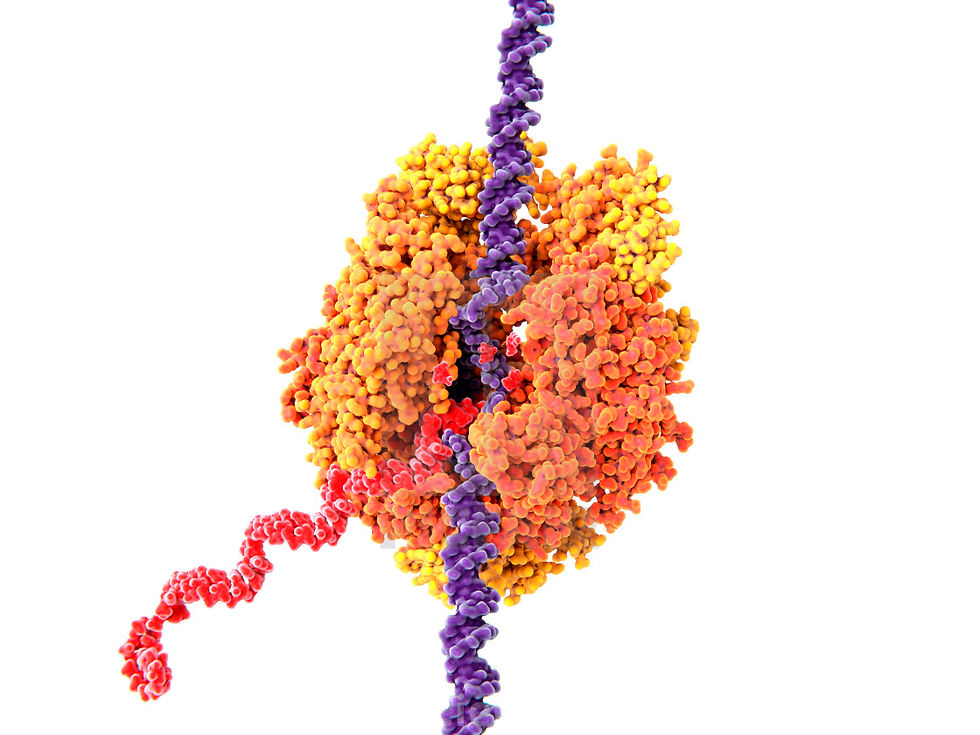
2) We need to maintain the pH is this whole process for the Taq polymerase to work effectively hence we use a 10x buffer (25 mM MgCl2, 500 mM KCl, 100 mM Tris-HCl, pH 8.3, 25°C).
3) To carry out the replication, Taq polymerase requires free bases, which it obtains from the dNTP's(a mixture of dATP, dCTP, dGTP, and dTTP) dissolved in the solution.
4) To guide the polymerase to the target sequence, we require RNA primers dissolved in Nuclease free water along with all of the above-mentioned components.

5) The temperature profile of a PCR cycle is controlled by the thermal cycler program.

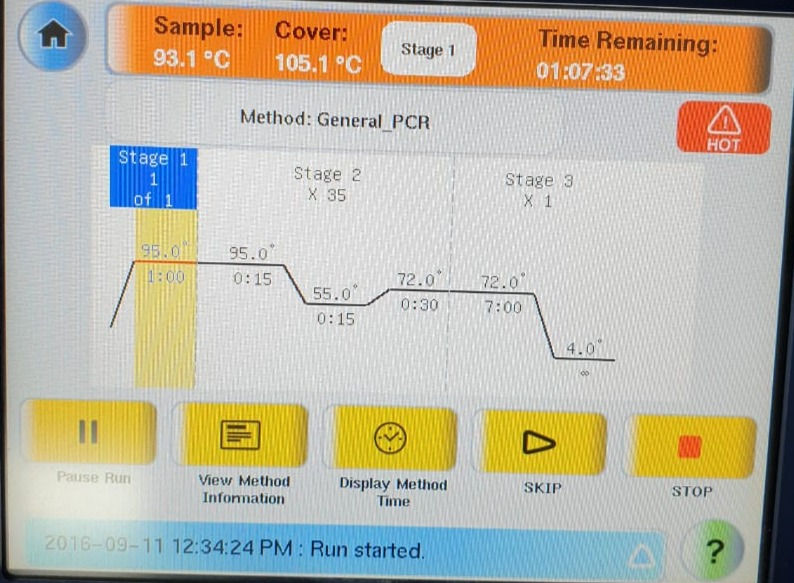
To get an idea of the experimental process, please refer to the experiment protocol.
STEP-1 Denaturation
Breaking of the hydrogen bonds to separate the double helix into its constituent strands. We obtain the template strand, which runs along the 5'- 3' direction. The Thermal cycler maintains a temperature of 96 °C at this stage.
STEP-2 Annelation
The primers, which are complementary sequences, bind to the template strand. The temperature is cooled to 55°C at this stage.
STEP-3 Extension
The polymerase acts on either side of the primers to extend the sequence. The temperature is raised to 72°C at this stage.

Experiment Protocol
Images


Result



Very informative. Awesome